Around 40% of all Bellrovians (Bellroy staff) queried our BigQuery data warehouse in the last 90 days, either directly or through a Google Sheet. Having worked in large organisations for most of our careers, we’re used to numbers closer to 5-10%.
Almost half the company is a lot of people for the small team behind Bellroy’s data platform to support, and at times it overwhelms us with work and support requests. Despite that, the team made a lot of progress in 2026 and we wanted to share it.
Here’s what we did.
Moving the engineering bottleneck
Historically, getting new data into our warehouse meant going through our small team of data engineers. They would set up pipelines in Apache NiFi and land the data in our Postgres database, before it was moved to BigQuery for analytics. Analysts, meanwhile, built what they needed with the tools they had: scheduled queries, local scripts and spreadsheets. Requests waited on engineers who had more work than was possible.
This year we’ve worked to ease that bottleneck in three ways:
- Direct to BigQuery: Data that’s only needed for analytics now goes straight to BigQuery. Using a pattern we created with dlt, we’ve cut the time to get a medium-sized API into production from around 10 days to less than 1.
- Migration to dbt Core: Transformations and business logic are moving out of NiFi and scheduled queries into a single dbt project that engineers and analysts share. The number of Bellrovians regularly contributing to our dbt project has gone from 3 to 9 a month and the number of models has almost doubled. Our NiFi footprint is shrinking too - active processors are down 15% - and we’ll do more next year.
- AI development: AI has made all of us significantly faster, and we see the biggest gains with tools like dlt and dbt that focus on local developer experience. We’re also finding ways to integrate with tools that don’t, like the UI-based NiFi. See the example below for how we did this.
In the last couple of months we’ve started to notice the change. We feel more in control of our backlog and we’re beginning to find more time to work on our platform. We still have bumpy weeks, but they seem to be less common than before (fingers crossed).
Example: using AI to build a declarative wrapper around NiFi
NiFi is a graphical user interface (GUI) tool, which makes it hard for Claude to work with. Because we still have a lot of NiFi flows, we’ve developed a tool to turn them into testable code.
NiFi flows are built by dragging processors onto a canvas. We version them in a Git repo, but what lands there is exported JSON: thousands of lines of universally unique identifiers (UUIDs), canvas coordinates and escaped SQL. Claude could edit it, but a small change like adding a retry rule touched dozens of keys. Nobody wanted to review the diff and the only way to test an edit was to import it into a running NiFi and click through it.
To fix this we built a framework we call Nifty. It’s a declarative Python framework where a flow is a short file: processors are added to a group and wired together. A deployer syncs that definition to NiFi and keeps component IDs stable, so registry diffs stay clean. That gives us:
- Reuse: Dead-letter queues, Slack alerting and paginated API pulls are templates, not copied process groups. When we changed how failures alert, we changed one template and every flow picked it up.
- Testability: Unit tests check a flow’s structure without NiFi running. Integration tests run on a local docker compose stack with mocked APIs. Claude can make a change, run the tests, read the failure and fix it.
Here’s the Extract stage of one of our API extraction flows, as NiFi draws it. This one calls TWC, one of the systems used in our retail stores.
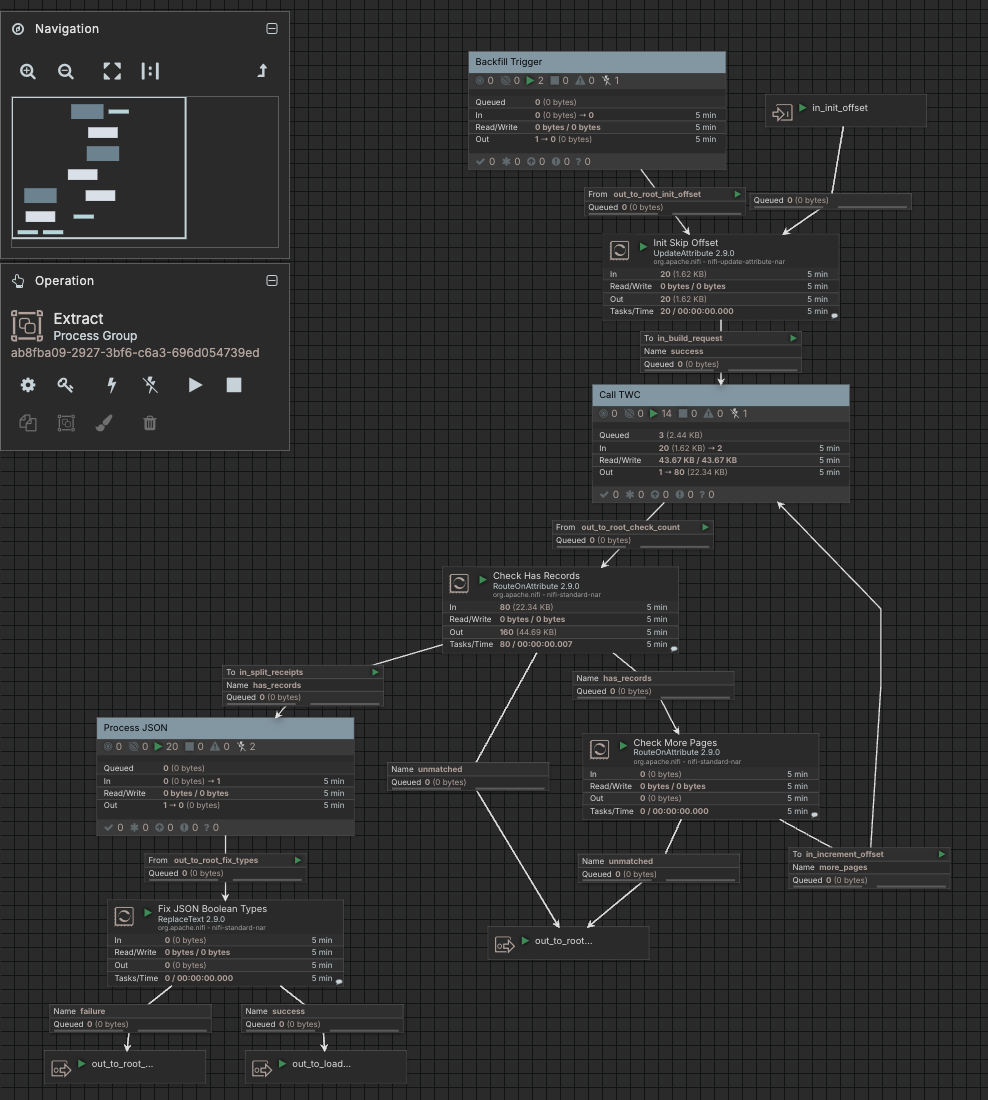
The same extract logic is used for all of our new paginated API calls. The Python behind it is a single file. The API call is a template we reuse in other flows and the loop that fetches the next page is one line. Claude can read that file, edit it and run the unit tests to check the flow is still wired the way we intended. When it makes changes we can run our regression tests and iterate locally without a human in the loop.
We still get much better results with tools that focus on local developer experience like dlt and dbt, but this has been a solid band-aid to improve the reliability of our existing stack.
The underlying code
with pg.group("extract", "Extract") as extract:

    # Manual re-pull of a past date range (switched off by default)
    with extract.group("backfill", "Backfill Trigger") as backfill:
        trigger = backfill.add("backfill_trigger", Processor(
            type_="GenerateFlowFile", name="Backfill Trigger (manual only)",
            disabled=True))
        bounds = backfill.add("backfill_bounds", Processor(
            type_="UpdateAttribute", name="Set Backfill Bounds",
            properties={"lower_timebound": "#{backfill_lower}",
                        "upper_timebound": "#{backfill_upper}",
                        "is_backfill": "true"}))
        trigger.route("success", bounds)

    # Start at page one of the API results
    init_offset = extract.add("init_offset", Processor(
        type_="UpdateAttribute", name="Init Skip Offset",
        properties={"skip_offset": "0"}))
    bounds.route("success", init_offset)

    # Fetch one page from the API, with retries (using a template)
    api = create_paginated_api_pg(
        extract, "call_twc", "Call TWC",
        remote_url="#{env_twc_api_url}/chqapi/export/purchase-receipt",
        request_body=TWC_EXPORT_REQUEST_BODY,
        page_size=500, max_retries=3)

    # Did the page return anything?
    check_count = extract.add("check_count", Processor(
        type_="RouteOnAttribute", name="Check Has Records",
        properties={"has_records": "${export_count:gt(0)}"}))

    # A full page means there may be another one
    check_more = extract.add("check_more", Processor(
        type_="RouteOnAttribute", name="Check More Pages",
        properties={"more_pages": "${export_count:equals('500')}"}))

    # Split the page into records, pull out fields, bad records go to a dead letter queue (DLQ)
    with extract.group("process_json", "Process JSON") as process_json:
        ...  # split -> hash -> extract fields -> build_record, with its own DLQs

    # Fix a type quirk so the database accepts the JSON
    fix_types = extract.add("fix_types", Processor(
        type_="ReplaceText", name="Fix JSON Boolean Types", ...))

    # Wiring
    init_offset.route("success", api.build_request)         # into the API call
    api.check_successful.route("success", check_count)      # out of the API call
    check_count.route("has_records", check_more)
    check_count.route("has_records", split_receipts)        # into Process JSON
    check_more.route("more_pages", api.increment_offset)    # pagination loop back
    build_record.route("success", fix_types)                # out of Process JSON
    fix_types.route("failure", log)                         # -> out_to_root
    check_count.route("unmatched", mark_gate)               # -> out_to_root
    check_more.route("unmatched", mark_gate)                # -> out_to_root
Keeping up with AI demand
More Bellrovians are working with our data than ever and AI is changing how they do it. We’re trying to keep up and give them the tools and data they need:
- Interactive dashboards: Some Bellrovians want to build their own custom HTML dashboards with Claude. So we’ve created a self-serve platform on Google Cloud Platform (GCP) that lets them deploy those dashboards to the rest of the business, with access controls.
- Asking questions of the data: Bellrovians want to explore and ask questions of our data directly in Claude. So we’ve started to build Anowlitics, a dedicated project with curated data and documentation to give Claude what it needs to answer their questions well.
More Bellrovians using our data in these new ways also puts pressure on us to get the basics right, so our data is AI-ready. We’ve been working on:
- Access management: We’ve moved all our GCP infrastructure to Terraform and tightened our Identity and Access Management (IAM) to role-based access controls, narrowing permissions to what people actually need to do their jobs.
- Documentation: We’re documenting our most valuable data in dbt Core so Claude has the context it needs to use our data. Datasets now have a reference document explaining what they are, how they work and their limitations.
More users, lower costs
Unsurprisingly, as more data and more Bellrovians use BigQuery, our platform costs have been trending up. We’ve done two things to get on top of this and bring them back down:
- Finding problem queries: We deployed BQ Booster, a dbt project we owe a huge shout-out to, and built models and dashboards on top of it to detect cost anomalies and problem queries. It showed us which queries to optimise first and now alerts us to new ones early so we can fix them. We’ve prevented a few big cost spikes after migrations and new builds by catching these problems early.
- Switching to slot-based pricing: The team at Google Cloud have been extremely supportive. At their recommendation we moved from on-demand to slot-based pricing with autoscaling. This costs us around half as much as running the same workload on-demand, which is a massive saving.
So despite all the investment in our platform and more Bellrovians using our data with AI, our costs are going down, not up - and those savings are funding our work.
Wrapping up
A small team did all this work: three data engineers and two data analysts. We also contributed to Bellroy’s strategic projects (like helping launch our first retail stores) and completed other work requests for the business, typically about 5 a month.
We’re lucky at Bellroy because we’re not held back by the politics and bureaucracy we’ve seen in larger organisations. That makes work a lot more fulfilling and lets us get a lot done with fewer people.
It sometimes felt bumpy along the way and we’ve made more progress in some areas than others. But all in all, we’re really proud of the effort the whole team has put in this year and can’t wait to see what we can do in 2027.